Category Archives: Food and Drink

Never Too Many Cooks: Female Alliances in Early Modern Recipes (Part II)

By Amanda E. Herbert

This page from Anne Brumwich’s recipe book shows contributions by different authors, with different styles of handwriting. Anne Brumwich and Others, 1625–1700, MS 160. Image courtesy of the Wellcome Library, London.

In this blog post and in my previous post, I’m presenting material from my forthcoming book: Female Alliances: Gender, Identity, and Friendship in Early Modern Britain (New Haven: Yale University Press, 2014).  The material in this post comes from Chapter Three, “Cooperative Labor: Making Alliances through Women’s Recipes and Domestic Production.”

In my last post, I discussed how early modern advice books encouraged women to work together in kitchens.  But did women follow these directions in their own homes?  Kitchen accidents and mistakes of course caused tempers to fray.  When Elizabeth Freke discovered that her servant had damaged a pot, she was so angry about it that she recorded it in her kitchen inventory, saying that the pot had been “brok out by Amey”!  But you can also find proof of women’s attempts to foster positive relationships with each other.

One of the best sources for understanding “real” early modern women’s work in kitchens is through their manuscript – handwritten – recipe books.  Recipe books were living manuscripts, typically added to and amended by many people. Women collected recipes from their female and male friends and noted donors’ names next to borrowed recipes in their books. Jane Baber’s manuscript recipe collection of 1625 included eight attributions from other women, among them a recipe “for the woorms” she had received from her “sister Earnly.” Women probably did exchange these recipes in person, but manuscript evidence shows that they also received them in correspondence from their female friends and relatives.  In the later seventeenth century, Anne Lany scrawled a recipe “for Guidiness of the head” on the back of her letter to her friend Anne De Gray. Sometimes women valued the recipes that they received from friends over those offered by male physicians: Beatrix Clerke wrote in 1665 that she hoped to procure a recipe from her friend Lucy Hastings, stating that she “doth believe that your Honor’s study and practice in phisicke is above our docters.”

Even the recipes themselves show how women helped one another in the kitchen. Female authors wrote recipes from a communal perspective. Mary Bent’s recipe book featured instructions on how “to pickle cowcombers the best way,” and the author noted that “you may put a little pepper in if you please but we do not.” The use of the plural “we” here suggested that, for the recipe’s author, pickling cucumbers was a communal rather than a solitary activity.

Women thus counted on one another for help in the kitchen, but they also used their recipes to advance female independence. Women’s recipes allowed them to share knowledge about acquiring materials and ingredients, navigating through urban spaces, and negotiating with shopkeepers. Many recipes encouraged women to purchase supplies in London, which had large numbers of apothecary shops. “M.B.’s” recipe of 1640 “to whiten the Teeth” called for “the stones of crabbs,” and readers were told that “you may buy [them] at the Redd Crosse in Cheap side a drugist.” An anonymous mid-seventeenth-century woman’s book recorded that “Vatican Pills” could be purchased from “the Apothecary . . . in the old Bayly in London.” Anne Brumwich’s book contained a recipe for a lotion that was said to prevent hair loss, and the ingredients for this lotion had to be purchased at “a Chymist a dutchmans in high holborn neare Grayes Inn field.” And Mary Chantrell’s book had a recipe for “an Excellent Coole pummatum [pomatum] for the face,” with ingredients that could be purchased “in See Lane in Holbourn.” From Gray’s Inn to Cheapside and from the Old Bailey to Holborn, early modern women used the information they gleaned from the recipe books of friends and relatives to traverse urban space. This knowledge was surely both useful and empowering. By furnishing women with information about reliable dealers, fair prices, and shop locations, handwritten recipe books allowed female recipe authors and their readers to share vital knowledge with one another and assert their independence in London’s streets and alleys.

*****
Manuscripts cited in this blog post:
1. Elizabeth Freke, “Kitchen Inventory,” October 18, 1711, Freke Papers, MS 45718, British Library.
2. Jane Baber, Recipe Book, 1625, MS 108, f. 18, 22, Wellcome Library.
3. Anne Lany, Letter to Anne De Gray, c. 1670, Correspondence of the Family of Gawdy, ADD 36989, F540, British Library.
4. Beatrix Clerke, Letter to Lucy Hastings, Countess Huntingdon, 1665, Hastings Collection, Box 25 HA 1466, Huntington Library.
5. Mary Bent, Recipe Book, 1664, MS 1127, f. 2, Wellcome Library.
6. Anonymous Woman [Possibly Mrs. M. Baesh], Recipe Book, 1640, MS 8086, f. 14, 19, 35B, 54, 81, 94–94B, and 102, Wellcome Library.
7. Anonymous, [possibly “EG”], Recipe Book, 17th c., MS 7391, Wellcome Library.
8. Anne Brumwich and Others, 1625–1700, MS 160, f. 94, Wellcome Library.
9. Mary Chantrell and Others, Recipe Book, 1690, MS 1548, f. 84, Wellcome Library.

Robert Herrick’s penchant for (feminine) almonds

By Colleen Kennedy

 THE BRIDE-CAKE.
by Robert Herrick
THIS day, my Julia, thou must make
For Mistress Bride the wedding-cake :
Knead but the dough, and it will be
To paste of almonds turn’d by thee :
Or kiss it thou but once or twice,
And for the bride-cake there’ll be spice.
(from Hesperides, 1648)

In this sweet trifle of a lyric, Robert Herrick does not actually dispense any practical cooking advice, but the poet notes that the flavor of Julia’s hands as she kneads the dough will impart the savor of “paste of Almonds” and that by kissing the dough, her sweet breath will give it the needed “spice.” Herrick, marrying together some of the aesthetic and feminine associations with almonds found in recipe books and medicinal manuals, alongside his larger appreciation of Classical sources, creates a gendered poetics of almond. In Herrick’s poem, as his own sweet mistress bakes almond-flavored bridal-cakes, we can sniff out that the almond was perhaps still thought to be under Venus’ influence in seventeenth-century England, associated with the erotic, the fertile, the beautiful, and the marital.

(Detail) Almond Tree from Gerard's "Herball"
(Detail) Almond Tree from Gerard’s “Herball” (via www.BioLib.de)

As Laurence Totelin suggests in a recent post on the aromas of garlic, almonds, and ancient fertility testing, “The smells used here were not chosen at random. Perfumes, such as that of bitter almond, were associated with Aphrodite, love making and marriage ceremonies.” Herrick’s corpus The Hesperides refers to an ancient garden of the Classical gods, and in his many poems he emulates the styles, forms, themes, and subjects of his many Greco-Roman poetic ancestors. Herrick’s Julia is a fictionalized and idealized ‘nymph,’ and her role in making bridal-cakes is especially fitting for an acolyte of Venus.

Bitter almonds (and their related products, such as almond milk) are lauded for their obstetric properties in Gerard’s Herball, such as helping alleviate the after pains of birth: “It is good for women newly delivered; for it quickly removeth the throwes which remain after delivery.” John Pechey’s The Compleat Midwife’s Practice (1698) lists the proscriptions and allowances on “How to Govern Women in Child-bed,” and suggests that along with a careful diet (and lots of claret), “She may also take at the discretion of those about her, Almond-milk now and then.”

While Julia must indulge in some domestic labor, Herrick displaces much of the drudgery onto Julia’s sweet essence. A contemporary almond paste recipe in The French Perfumer (1646) demonstrates that this is a multistep process including scalding the almonds, peeling, air-drying, beating, running through a sieve, layering with flowers, mixing frequently, and pressing for the oil. This last step alone is time consuming: “Observe that in the Composition of Essences … the… Paste must be in the Press three hours at least to draw the Oyl.”

Yet, Herrick’s Julia does not need to toil or press or scald because (in his fantasy) her skin exudes essence of almond as she prepares the bridal-cakes. Almond, due to the moisturizing qualities of its natural fats and oils, and also the exfoliating properties of its shell, is a common recipe in soaps.[1] In The Queens closet opened (1659), offers a delectable and highly fragrant soap recipe (“To make an Ipswich Water”) with white Castile (vegetable fats) Soap, rose-water, marjoram, savory, oil of cloves and spike(nard), musk and ambergreece, “work all these together in a fair Mortar, with the powder of an Almond Cake dried, and beaten as small as fine Flower, so roll it round in your hands in Rosewater.”

Hannah Wooley offers an aromatic and flavorsome almond milk recipe in The Queen-Like Closet (1670).

To make good Almond-Milk.

 Take Jordan Almonds blanched and beaten with Rosewater, then strain them often with fair water, wherein hath been boiled Violet Leaves and sliced Dates; when your Almonds are strained, take the Dates and put to it some Mace, Sugar, and a little Salt, warm it a little, and so drink it.[2]

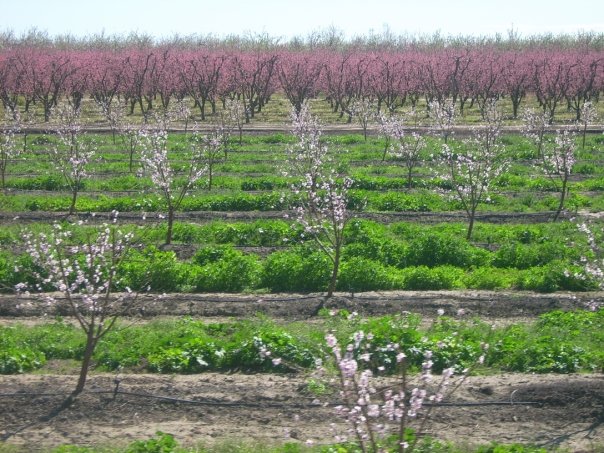
a grove of almond trees in California (March 2009) (image from Wikimedia Commons)

Herrick’s Julia is not his only mistress associated with the aromatic, sensuous and aphrodisiacal almond. In his epigram “Upon Sibilla,” he conflates overtones of the occasional erotics of almonds, domestic labor, the beautiful and fertile housewife, and the recipes that blur lines between edible and topical concoctions. This results in a poem that hyperbolically celebrates Sibilla’s desirability and her homely, domestic attributes:

 With paste of almonds, Syb her hands doth scour;
Then gives it to the children to devour.
In cream she bathes her thighs, more soft than silk;
Then to the poor she freely gives the milk.

In these recipes, but especially Herrick’s poetic appropriations, we learn that almond-products might be gendered feminine, whether through the associations with Aphrodite/Venus, as an obstetric remedy, a beautifying elixir, sweetly scented hand soaps, or even in a perfumed drink. All were appropriate not only for bridal-cakes, but also for Herrick’s idealized mistress.

 [1] See my earlier post on Renaissance scented bath waters and soaps, including another almond recipe: “A Sweet Bath and Sweating: Renaissance Ladies and Bathing.”

[2] See my previous posts on early modern violet and civet and rosewater.

Different ways to cook a rabbit: Georgiana Hill and Mrs Beeton

By Rachel Rich

Georgiana Hill's cookbooks are serious books for serious foodies.
The sober title page matches Georgiana Hill’s serious approach to cookery. Credit: The Internet Archive


Georgiana Hill was a prolific cookery writer around the time when Mrs Beeton published her Book of Household Management (1861). Each woman wrote from an educated perspective, drawing on history and mythology to contextualise the ingredients they wrote about. Isabella Beeton was a young, successful journalist, who probably spent very little time in the kitchen. Much less is known of Hill’s life, but the introductions to her many publications, as well as the recipes themselves, suggest certain possibilities.

Unlike Beeton, whose Book includes recipes for every food imaginable, and advice about every aspect of domesticity, Hill keeps her focus solely on the food. In the introduction to The Gourmet’s Guide to Rabbit Cooking, In One Hundred and Twenty-Four Dishes (1859), Hill discussed her childhood fascination with rabbits, before moving on to their culinary purpose–a flight of fancy one can only imagine Mrs Beeton would have found pointless if not downright distasteful. Whereas Beeton depicted herself as the solidly English, economical and practical mistress of a well-run home, Hill consciously allied herself with the French ‘who possess an aptitude for delicacy of expression of which an English cook is totally deficient.’ Hill went on to write that ‘the charm of rabbits consists in their being so easily and agreeably accommodated (mark the word), and in their capability of producing a variety of compositions, which, if proceeding from the hands of an able artiste, may, for elegance, be ranked among the most recherché dishes that can dignify the table of refined and enlightened amphitryons.’

General advice for every eventuality, including the cooking of rabbits.
Mrs Beeton’s more ornate title page illustrates the contrast of her more domestic  femininity with Hill’s gender neural approach. Source: British Library/wikipedia

Hill’s recipes also differed from Beeton’s. Beeton started every recipe with a list of ingredients, then methodically went through the instructions, and finished with information about time, cost, number fed, and seasonability. Hill did not take up such modern practices, keeping rather to the traditional, discursive from. Thus, recipe 56 ‘To Curry Cold Rabbit’ reads:

Cut up two good-sized onions, one cucumber, two apples, and a slice or more of ham and cut into dice. Put these things into a stewpan, with a quarter of a pound of butter, and stir them well until they are done; then add your pieces of rabbit, and the juice of a lemon strained from the pips; shake it for a few minutes, pour in a pint of good stock, and let it simmer for twenty minutes, skimming frequently. When done, you can either dish it as it is, or arrange the rabbit in your dish, and strain the sauce through a sieve over it. Serve boiled rice apart.

The difference between Hill and Beeton is that Hill was writing as a cook and food enthusiast who assumed that her writers shared her passion. Beeton was writing for women for whom she imagined the running of the home to be a serious business: ‘As with the commander of an army, or the leader of any enterprise, so is it with the mistress of a house.’ Clearly each book found an audience and a market, but where Beeton wrote condescendingly to (imagined) morally and intellectually weak housewives, Hill chose a more neutral approach, calling herself ‘An Old Epicure,’ and eschewing domestic advice in favour of a specialist’s approach to food preparation.

Of Hedgehogs, Whale Vomit, and Fire-Breathing Peacocks

rotfling hedgehogs
Hedgehogs from a 13th-century bestiary. British Library, Royal 12 F XIII, fol. 45r. Found on the “Discarded Image” Tumblr

By Jennifer Sherman Roberts

I told my children we were making hedgehog pudding for Halloween.

They were horrified.

So was I when I read the title of an entry in the recipe book of Lady Ann Fanshawe (1625-1680), “To make a Hedg-hogg.” (I’ll admit to some hypocrisy in this. Why it would be more viscerally disgusting to eat a hedgehog than, say, a pig has to do with mere custom and perceived adorableness. That and the question of what to do with the sharp, prickly bits.)

The kids were relieved, as was I, to learn that the hedgehog in question was made up of only a few ingredients, and hedgehog wasn’t among them:

To make a Hedg-hogg

Take 3 pints of sweet creame, and boile in it some Nutmegg and Mace and when it boiles put in being very well beaten five Eggs white and all, and so stir it and let it boile and when it is turned to curds and whey poore it into a strainer and so hang in up to drayne for 6 or 8 houres when the whay is runne all out take halfe a pound of Almonds blanched and very finely beaten with Rosewater and temper them with the curd and sweeten it well with Sugar, and put some Rosewater and Ambergreice into it and soe make it up in the fashion of a Hedghogg and put in two Currants for the eyes and stick all Almonds all over the back of it, and put it into a dish and into the dish put white wine & Sugar or raw Creame and serve it to the table. (303)

This hedgehog, then, is not just food: it’s food art. It’s also an excellent example of the early modern period’s preoccupation with making food look like something it’s not, turning the gustatory experience into a visual pun or trick–nourishment for the eyes as well as the palate. Ken Albala, writing about the banquet in Europe between 1520 and 1660, discusses this predilection for spectacle: “a meal [was] a form of theater . . . replete with an audience, stage sets, props, and interludes.” He goes on to note that “if abundance and variety itself could no longer impress, then culinary virtuosity, wit, and allusion take their place” (12).

As the wife of Sir Richard Fanshawe (1608-66), ambassador to Madrid, Lady Anne Fanshawe’s table would have been such a place of political theater, a stage for displaying power, wealth, position, and intention.

An examination of the rest of Fanshawe’s recipe book, however, finds that the entries tend more to the useful, practical, and every day. In this, it is an example of the growing popularity of cookbooks for women in this period. Sara Mueller notes that “prior to the late sixteenth century, elaborate banquets . . . were prepared by professional male chefs for royal, aristocratic, and ecclesiastical households. However, beginning in the late sixteenth century and continuing throughout the seventeenth century, cookery books featuring banqueting receipts began to be published on a large scale” (107).

Lady Ann Fanshawe’s recipe collection was not published; rather, like other early modern receipt books, it was a highly personal and eclectic assortment of instructions for things as diverse as making laudanum, concocting a powder to aid in miscarriage, and stewing a lamb’s head.

But like those banqueting recipes in the published cookbooks, the inclusion of this recipe points to a common theme in early modern aesthetics: the interplay of art and nature. In this case, that intimate connection is implicit in the cooking process: like other fields of artistry, raw materials are transformed by skill, by techne. Mueller provides an extraordinary example of this preoccupation with culinary transformation that highlights the maker’s artistry:

After giving a detailed receipt for cooking a peacock that will look even more striking dead than it did alive—a feat achieved by carefully killing the bird, removing the flesh from the still-feathered skin, roasting the flesh, and then sewing the cooked flesh back into the raw skin—the English translation of Giovanne de Rosselli’s receipt book, Epulario, or The Italian Banquet, published in England in 1598, gives instructions on how to make the dish even more spectacular: ‘If you will have the Peacoke cast fire at the mouth, take an ounce of Camphora wrapped about with Cotton, and put it on the Peacockes bill with a little Aquanity, or very strong wine, and when you will send it to the table, set fire to the Cotton, and he will cast ore a good while after. And to make a greater shew, when the Peacoke is rested, you may gild it with leafe gold, and put the skin upon the same gold, which may be spiced very sweet.'(106)

Lady Fanshawe’s homey little hedgehog pudding was not intended to compete with the grandeur of the transformed (and reformed) peacock described here, but as disparate as they are, the two dishes share an emphasis on transfiguration and display.

As for our little hedgehog pudding, the kids and I agreed that we would leave out the ambergris. None of us wanted to hunt down a source for expensive whale vomit, which in any case is for the best. I’ve since learned that it’s illegal to possess ambergris in the United States. I bought some rosewater at a local Lebanese restaurant/store, and I cooked up the curds and whey while the kids were at school. Our final creation was a bit squat, a bit formless, but identifiable as a hedgehog. It tasted sweet, the rosewater a faint scent that I imagine would have been overdone by the distinctive, earthy ambergris. Overall, it was a conditional success… It worked, but I wouldn’t do it again.

hedgie
Here’s the homely, humble little hedgehog we made. He’s a bit formless, but he made up for it with very yummy prickles.

I do not think we’ll be attempting the gold-leafed, fire-breathing peacock for Thanksgiving. Turkey will do, thank you very much.